

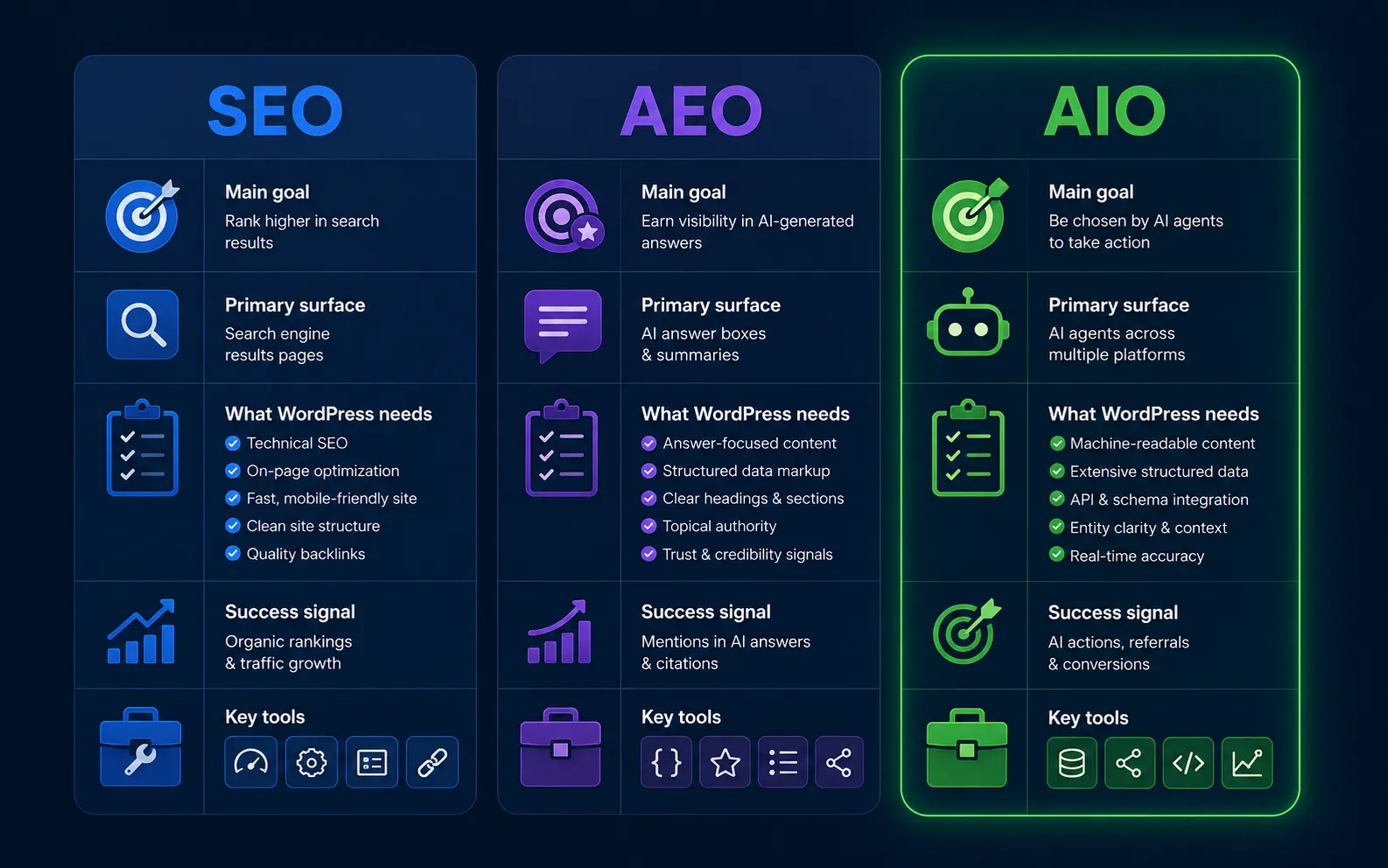
Yoast and Rank Math are still the safer choices for classic WordPress SEO. Aetos is the better fit when the job is AI Optimization: crawler access, llms.txt, extractable answers, citation readiness, and multi-AI provenance. The best setup is usually not either/or. It is one SEO plugin plus Aetos.
Yoast vs Rank Math used to be a plugin debate: which one gives better title controls, schema, sitemaps, redirects, and content scoring? That still matters. Google has not replaced standard SEO with a separate AI-only checklist; its own AI features guidance says standard SEO practices remain relevant and no special AI text file or special schema is required for AI features in Google Search.
But the WordPress SEO stack now has a second job. Your site needs to be crawlable, understandable, quotable, and traceable across ChatGPT, Claude, Perplexity, Google AI features, and other answer systems. That is where the comparison changes. Yoast and Rank Math help you publish better pages. Aetos audits whether those pages are ready to be found, parsed, cited, and attributed by AI systems.
30-second answer
Choose Yoast if your team wants mature editorial guidance and a stable WordPress SEO workflow. Choose Rank Math if you want a faster-feeling, module-heavy SEO plugin with stronger AI writing tools. Choose Aetos if you need to audit AIO, not just write or optimize a page.
Here is the honest version:
- Yoast wins for authoring, readability, internal linking, schema maturity, and ecosystem trust.
- Rank Math wins for Content AI, modular controls, built-in analytics, and value-heavy SEO features.
- Aetos wins for AI Optimization audits: llms.txt, AI crawler rules, citation structure, semantic HTML, and multi-AI provenance.
- Aetos loses if you expect it to replace Yoast or Rank Math inside the WordPress editor.
That last point matters. Aetos should not be installed mentally as “another SEO plugin.” It is an audit and readiness layer for AI search. You still need one canonical SEO plugin to handle title tags, meta descriptions, canonical URLs, XML sitemaps, structured data, social previews, redirects, and editor feedback.
The practical recommendation:
| Site type | Best setup |
|---|---|
| Solo blog | Yoast Free or Rank Math Free; run Aetos periodically. |
| Content-heavy publisher | Yoast Premium + Aetos, unless Rank Math’s workflow fits the team better. |
| Affiliate or review site | Rank Math + Aetos for schema, content workflows, and AI-readiness checks. |
| SaaS or product site | Yoast or Rank Math + Aetos for docs, pricing, llms.txt, and citation paths. |
| Agency managing many WordPress sites | Rank Math or Yoast as the SEO base; Aetos for repeatable AI-readiness audits. |
If you already use Yoast or Rank Math, do not switch just because AI search is changing. Keep the plugin that runs your classic SEO cleanly. Add Aetos where the gap is real: AIO auditing.
The auditing tool table
Yoast and Rank Math audit pages for classic SEO signals inside WordPress. Aetos audits whether the site is ready for AI systems to crawl, understand, cite, and attribute it. That is the difference: page optimization versus AI-readiness auditing across infrastructure, content, and provenance.
| Capability | Yoast | Rank Math | Aetos |
|---|---|---|---|
| SEO title and meta controls | Yes | Yes | Audit-only, not the editor source of truth |
| Readability and content guidance | Strong | Good | Audits clarity and extractability |
| XML sitemap controls | Yes | Yes | Checks whether discovery paths support AI readiness |
| Schema output | Strong connected schema graph | Strong schema module and templates | Audits schema presence, consistency, and usefulness |
| Redirect management | Premium | Module-based | Flags citation and crawl issues caused by redirects |
| Internal linking help | Premium suggestions | Link suggestions in Content AI workflows | Audits crawl paths and citation routes |
| AI writing assistance | Titles, meta descriptions, content suggestions | Content AI for writing and optimization | Not primarily a writing assistant |
| AI crawler policy audit | Limited | Limited | Core use case |
llms.txt audit |
Not the core product | Not the core product | Core use case |
| Robots.txt for AI bots | Editable through normal workflows | Editable through normal workflows | Audits GPTBot, OAI-SearchBot, ClaudeBot, Claude-SearchBot, PerplexityBot, Google-Extended decisions |
| Multi-AI provenance | Not the core product | Not the core product | Core use case |
| AI citation criteria | Indirect | Indirect | Core use case |
| Best fit | Classic SEO publishing workflow | Classic SEO plus AI-assisted content workflow | AI-readiness and AIO audit workflow |
Yoast’s official materials emphasize real-time SEO feedback, readability, schema, AI-assisted titles and meta descriptions, internal linking suggestions, and redirects in Premium. Rank Math’s official materials emphasize modular SEO controls, Content AI, schema, Search Console and Analytics integration, keyword tracking, redirects, and SEO analysis tests.
Aetos is different because the audit target is different. It is not asking only “is this post optimized for a focus keyword?” It is asking questions like:
- Can AI crawlers access the pages you want cited?
- Are training crawlers blocked or allowed intentionally?
- Does the site have a useful
/llms.txt? - Do pages have answer-first sections that can be extracted cleanly?
- Are headings and semantic HTML helping machines understand the page?
- Do canonical URLs, redirects, and noindex rules conflict with AI visibility?
- Can claims be traced to visible sources?
- Are entity signals consistent across the site?
- Are important pages buried behind scripts, tabs, or thin templates?
- Is the page likely to be cited by ChatGPT, Claude, Perplexity, or Google’s AI features?
That is why the comparison is not “Yoast vs Rank Math vs Aetos” in the normal plugin-review sense. It is “classic SEO tools vs an AIO audit layer.”
Where Yoast wins: authoring + ecosystem
Yoast wins when the job is helping writers and editors publish technically safe WordPress content. Its strengths are familiar: readability feedback, SEO analysis, metadata controls, automatic structured data, internal linking suggestions in Premium, redirects, and a large ecosystem of documentation and support.
The reason Yoast still matters in 2026 is not nostalgia. It gives non-technical teams a predictable workflow. Writers understand the traffic lights. Editors understand the readability checks. Developers understand where schema, breadcrumbs, canonicals, and sitemaps are coming from. Clients understand the brand.
Yoast’s structured data approach is a real advantage for many teams. Yoast says it generates Schema.org structured data automatically and builds a connected schema graph that describes the site, content, organization, and relationships. That is not “AIO” by itself, but it is still useful because AI systems and search engines benefit when page meaning is clear.
Yoast also wins in editorial process. Its best use case is not writing the article for you. It is catching issues while a human is working:
- missing or weak SEO titles
- thin meta descriptions
- unfocused keyphrase usage
- poor readability
- weak internal linking
- missing redirects after URL changes
- basic schema gaps
- content that is hard for search engines to interpret
This is where Yoast feels boring in the best way. It does not try to turn every screen into an AI command center. It helps teams publish clean WordPress pages repeatedly.
Where Yoast loses: it is not built around multi-AI citation auditing. It can help make a page clearer, and that can help AI systems indirectly. But it does not replace an audit of OAI-SearchBot, GPTBot, ClaudeBot, Claude-SearchBot, PerplexityBot, Google-Extended, /llms.txt, extractability, answer blocks, or source provenance.
Use Yoast when you care about stable publishing governance. Add Aetos when you need to know whether that publishing system is ready for AI discovery and citation.
Where Rank Math wins: Content AI + speed
Rank Math wins when you want more SEO controls in one plugin, a modular setup, and stronger AI-assisted content workflows. Its Content AI product is more central to the Rank Math experience than Yoast’s AI features are to Yoast. It also feels faster and more configurable to many technical users.
Rank Math’s official WordPress plugin page lists Content AI, schema, Search Console integration, keyword tracking, Analytics integration, a setup wizard, redirections, SEO analysis, and a module-based system. That module system is a practical advantage. If you do not need a feature, you can disable the module and keep the dashboard cleaner.
Content AI is the clearest Rank Math advantage. Rank Math positions it as a WordPress-native AI assistant for SEO-friendly content, with dynamic suggestions, questions with schema markup, link suggestions, related keywords, and AI writing workflows. For teams producing many posts, landing pages, or product descriptions, that can save time.
Rank Math also tends to appeal to users who want:
- more features in the free plugin
- multiple focus keywords
- schema controls
- analytics inside WordPress
- keyword position tracking
- modular setup
- redirection controls
- easy migration from another SEO plugin
- a dashboard that feels more technical and configurable
Where Rank Math loses: AI-assisted content is not the same as AI-readiness auditing. A tool can help you write a better article and still miss whether that article is easy to cite, whether the site blocks the wrong crawler, whether /llms.txt points to stale pages, or whether the canonical path breaks attribution.
Rank Math’s Content AI also has its own pricing and usage model. Rank Math’s official documentation says Content AI moved away from a credit-based system to feature-based monthly limits starting with specific Rank Math SEO and PRO versions. That is worth checking before you commit a content team to it.
Use Rank Math when you want a powerful SEO plugin with strong AI authoring support. Add Aetos when the question shifts from “is this content optimized?” to “can AI systems find, parse, cite, and attribute this content correctly?”
Where Aetos wins: AIO + audit depth + multi-AI provenance
Aetos wins when the goal is not writing the page, but auditing whether WordPress is ready for AI citation. It looks at the layer Yoast and Rank Math only touch indirectly: crawler policy, llms.txt, semantic structure, citation eligibility, provenance, and AI-specific technical conflicts.
AIO is not one thing. It is a set of checks across infrastructure, content, and evidence.
For a WordPress site, AIO includes:
| AIO area | What needs checking |
|---|---|
| AI crawler access | Whether search/citation bots are allowed and training bots are handled intentionally. |
| robots.txt | Whether GPTBot, OAI-SearchBot, ClaudeBot, Claude-SearchBot, PerplexityBot, and Google-Extended rules match the business goal. |
| llms.txt | Whether /llms.txt exists, is curated, and points to pages that actually explain the site. |
| Extractability | Whether answers, definitions, tables, steps, and summaries can be pulled cleanly. |
| Semantic HTML | Whether headings, lists, tables, schema, and visible text make page meaning clear. |
| Provenance | Whether claims, authorship, sources, update dates, and entity signals are visible. |
| Internal citation paths | Whether important pages link to each other in ways AI systems can follow. |
| Multi-AI readiness | Whether the site is prepared for ChatGPT, Claude, Perplexity, Google AI features, and other answer systems with different crawler behavior. |
This is where Aetos has a sharper job. It does not need to beat Yoast at Yoast’s job. It does not need to beat Rank Math at Rank Math’s job. It needs to answer the question neither plugin was originally designed to answer:
“What prevents this WordPress site from being understood, trusted, cited, or attributed by AI systems?”
The answer may be technical. For example, the site might block OAI-SearchBot while allowing GPTBot, which is backwards if the site wants ChatGPT citations but not training use. OpenAI says OAI-SearchBot and GPTBot are separate robots.txt controls with independent settings.
The answer may be platform-specific. Anthropic distinguishes ClaudeBot, Claude-User, and Claude-SearchBot, with Claude-SearchBot tied to search result relevance and Claude-User tied to user-directed retrieval.
The answer may be citation-specific. Perplexity says PerplexityBot is designed to surface and link websites in search results, and is not used to crawl content for AI foundation model training.
Or the answer may be content-specific: a page has no concise definition, no useful table, vague headings, unclear authorship, or no visible support for the claim it wants to rank for.
Aetos also wins where teams need a repeatable checklist. The site owner does not want a vague “optimize for AI” recommendation. They want to know which of all 150 checks passed, which failed, and which ones affect AI citation eligibility.
Where Aetos loses: it is not the editor layer. It does not replace the day-to-day content controls that Yoast and Rank Math handle well. It should not be your only SEO system on WordPress. The clean setup is Aetos plus one SEO plugin, not Aetos instead of one.
When to pair Aetos with Yoast or Rank Math
Pair Aetos with Yoast or Rank Math when you want one tool to manage classic SEO output and another to audit AI-readiness. Do not run Yoast and Rank Math together. Pick one SEO plugin as the source of truth, then let Aetos inspect the site for AIO gaps.
Use Yoast + Aetos when:
- writers need clear readability and SEO feedback
- editors want a conservative workflow
- the site already relies on Yoast schema and sitemaps
- Premium internal linking suggestions are part of the process
- redirects are managed through Yoast Premium
- clients or editors are already trained on Yoast
- AIO is needed as an audit layer, not a writing layer
Use Rank Math + Aetos when:
- the team wants Content AI inside WordPress
- the site needs modular SEO controls
- schema customization matters
- keyword tracking and analytics inside WordPress are useful
- the agency manages many personal or client sites
- editors prefer a more feature-rich dashboard
- AIO audit needs to sit beside a more technical SEO plugin
Avoid Yoast + Rank Math together. Both can output titles, meta descriptions, canonicals, schema, Open Graph tags, sitemaps, and redirects. Running both can cause duplicate metadata, conflicting schema, incorrect canonicals, and plugin debugging work that looks like SEO but is really cleanup.
Aetos does not create that same conflict if it is used as an audit layer. It checks whether the site is ready for AI search and citations. It does not need to own your title tag or sitemap output to do that.
A simple stack:
Classic SEO source of truth:
- Yoast or Rank Math

AI-readiness audit layer:
- Aetos

Supporting AI files and policies:
- /robots.txt
- /llms.txt
- schema
- semantic HTML
- clear internal links
This also matches the structure of a modern AIO program. Start with the AIO pillar guide for strategy. Use robots.txt rules for AI bots to control crawler access. Publish a clean llms.txt for WordPress so AI systems get a curated site brief. Improve semantic HTML for AI so pages are easier to parse.
Then use Aetos to check whether the pieces work together.
Pricing breakdown
Yoast and Rank Math pricing is plugin pricing. Aetos pricing is audit-layer pricing. Compare them by job, not only by annual cost. A cheaper SEO plugin is not cheaper if it leaves AI-readiness unmeasured. Aetos is not expensive or cheap until you compare it with the cost of manual AIO audits.
Current public pricing can change, so check the vendor pages before purchasing. As of the source pages reviewed for this article, Yoast SEO Premium is listed at $118.80 per year before VAT on Yoast’s product page. Rank Math’s pricing page lists PRO at $7.99 per month billed annually before tax, with renewal at $8.99 per month, and higher Business and Agency tiers.
Aetos Pro uses annual licensing with current local-currency pricing published on the Aetos Pro pricing page.
| Tool | Public pricing model | What you are paying for | Best value when |
|---|---|---|---|
| Yoast Free | Free | Core SEO controls, readability, basic metadata and schema workflow | You need a reliable SEO baseline. |
| Yoast Premium | About $118.80/year before VAT, based on current Yoast page | AI title/meta help, redirects, internal linking, support, expanded SEO tooling | You want mature editorial SEO guidance. |
| Rank Math Free | Free | Many classic SEO modules, schema, analysis, and basic optimization | You want more controls without paying immediately. |
| Rank Math PRO | Listed from $7.99/month billed annually before tax, based on current Rank Math page | More SEO features, tracking, support, and higher limits | You want a feature-rich SEO plugin. |
| Rank Math Content AI | Separate usage model or plan-dependent access | AI-assisted content workflows inside WordPress | You publish many optimized pages and want AI help in the editor. |
| Aetos Free Audit | Free | AI-readiness snapshot for a URL | You want a quick diagnostic before investing. |
| Aetos Pro | Annual license; see current local-currency pricing | Recurring AIO checks across AI-citation criteria | You want AI-readiness monitoring, not another title/meta plugin. |
The decision is easier if you separate budgets:
- SEO plugin budget: Yoast or Rank Math.
- AI-readiness audit budget: Aetos.
- Content production budget: writers, editors, Rank Math Content AI, Yoast AI features, or other writing tools.
- Technical cleanup budget: developer time for schema, templates, robots.txt, llms.txt, performance, and internal linking.
If you are trying to spend as little as possible, use Rank Math Free or Yoast Free and run the Aetos AI-Readiness Audit on important URLs. If you are running a serious content site, the better question is not “which one is cheapest?” It is “which tool prevents expensive blind spots?”
A missing canonical tag is a classic SEO problem. Yoast and Rank Math can help.
A blocked citation crawler is an AIO problem. Aetos is built to catch that.
A vague article introduction is both a human problem and an AI extraction problem. Your editor should fix it, then Aetos should flag whether it is still hard to quote.
That division of labor is the cleanest way to think about pricing.
FAQ
Is Aetos a replacement for Yoast or Rank Math?
No. Aetos is not a replacement for a classic WordPress SEO plugin. You still need Yoast or Rank Math for titles, meta descriptions, canonicals, schema output, sitemaps, redirects, and editor guidance. Aetos is the AIO audit layer: AI crawler rules, llms.txt, citation criteria, provenance, semantic structure, and readiness gaps.
Which is better in 2026: Yoast or Rank Math?
Yoast is better for teams that value mature editorial guidance, readability checks, a large ecosystem, and a conservative workflow. Rank Math is better for users who want more built-in modules, Content AI workflows, keyword tracking, and a faster-feeling dashboard. Neither is purpose-built as a full AIO audit platform.
Does Yoast do AI Optimization?
Yoast has AI-assisted SEO features, including title and meta description generation, and it has strong structured data and editorial guidance. That supports AI-readiness indirectly. It does not replace a dedicated audit of ChatGPT, Claude, Perplexity, Google AI features, robots.txt AI bot rules, llms.txt, extractability, and source provenance.
Does Rank Math do AIO?
Rank Math does AI-assisted content well through Content AI, and it includes many SEO controls that support visibility. But Content AI is not the same as AIO auditing. Aetos is stronger when the job is checking whether a WordPress site is technically and structurally ready for AI systems to cite it.
Should I switch from Yoast to Rank Math for AI search?
Not automatically. If Yoast already manages your metadata, schema, sitemaps, redirects, and editorial workflow cleanly, switching may create more risk than benefit. Add Aetos first to find AI-readiness gaps. Switch SEO plugins only when Rank Math’s specific features solve a workflow problem Yoast does not.
Should I use Aetos with Yoast or Rank Math?
Yes. In most WordPress setups, use one classic SEO plugin and Aetos as the AI-readiness audit layer. Pair Yoast with Aetos if your team values editorial stability. Pair Rank Math with Aetos if your team wants modular SEO controls and Content AI. Do not run Yoast and Rank Math together.
Want Aetos to check whether your WordPress SEO stack actually supports AIO? Run the free AI-Readiness Audit — paste any URL, score in 30 seconds.